Safest Laser Treatment for Stubborn Pigmentation (2026)
The safest laser treatment for stubborn pigmentation depends on whether the problem is melasma, post-inflammatory hyperpigmentation, or sun spots, because each reacts differently to heat, wavelength, and skin tone.
Key Takeaways
For stubborn pigmentation, the safest laser is usually a low-heat, conservative option chosen after diagnosis, with Q-switched 1064 nm Nd:YAG and selected non-ablative fractional lasers generally preferred over aggressive pigment-targeting lasers in darker or melanin-rich skin [1][2].
Melasma is defined as an acquired pigmentary disorder that causes blotchy brown facial patches and is known to relapse, so the safest plan often combines sun protection, topicals, and carefully selected procedures rather than laser alone [3][4].
Skin tone changes laser safety: sources cited here note that some pigment lasers suit Fitzpatrick III-IV better, while darker types V-VI often need wavelengths and settings with less epidermal injury [2][5].
High-heat or poorly matched treatments can trigger rebound hyperpigmentation, hypopigmentation, or prolonged inflammation, which is why conservative treatment sequencing matters [1][2].
For stubborn pigmentation, the safest laser is usually a low-heat, conservative option chosen after diagnosis, with Q-switched 1064 nm Nd:YAG and selected non-ablative fractional lasers generally preferred over aggressive pigment-targeting lasers in darker or melanin-rich skin [1][2]. Melasma is a common acquired pigmentary disorder that presents as bilateral, blotchy brown facial pigmentation, as DermNet states [3]. That definition matters because “pigmentation” is not one condition. Melasma, post-inflammatory hyperpigmentation, lentigines, and mixed-pattern pigment often need different decisions. In everyday practice, the safest plan starts with identifying the pigment type, estimating depth, reviewing triggers such as sun exposure or hormones, and then deciding whether laser should be used now or delayed in favor of topical control first. For readers comparing options, the safest answer is not the strongest laser. It is the laser least likely to worsen color while still making steady progress.
What makes a laser treatment safest for stubborn pigmentation?
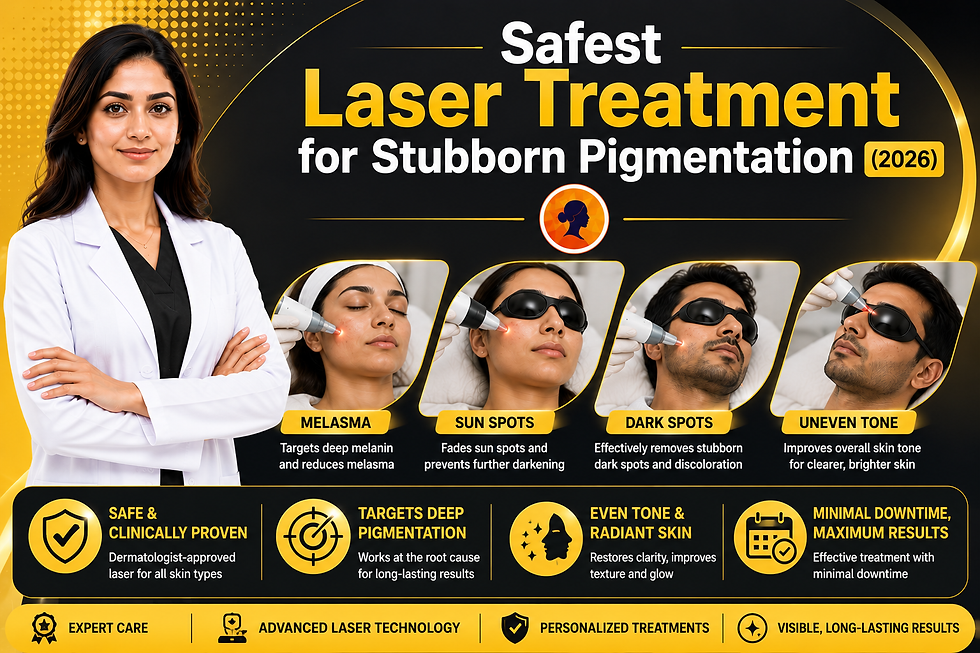
Safety starts with diagnosis, not device marketing
A safer treatment plan begins by separating melasma from freckles, lentigines, and post-inflammatory hyperpigmentation. The American Academy of Dermatology overview page on melasma and DermNet both describe melasma as a distinct pigmentary disorder, not just a generic dark spot problem [6][3]. DermNet defines melasma as a common acquired skin disorder with bilateral, blotchy, brownish facial pigmentation [3]. IADVL Public describes melasma as a chronic, relapsing pigmentary disorder, which helps explain why some cases need longer control and maintenance rather than quick escalation [7]. A plan that ignores diagnosis increases the chance of overtreatment.
The safest lasers usually reduce heat and epidermal injury
For darker skin tones, safety usually improves when the chosen wavelength penetrates more selectively and the treatment avoids aggressive surface damage. Dermatology Times reports that Q-switched 1064 nm YAG is safer in darker skin types, while long-pulsed lasers and intense pulsed light devices can also be a safer route in darker-skinned individuals [2]. The 2025 NIH-indexed review notes that Indian skin is usually melanin-rich and says modern lasers are built to treat darker skin tones safely, especially when Nd:YAG is used with the right strategy [5]. This is also why many patients searching skincare treatments Hyderabad need more than a menu of devices; they need careful matching of wavelength, fluence, and diagnosis.
Safest laser treatment for stubborn pigmentation: risk hierarchy by laser type
Usually safest first-line procedural options
Across the cited literature, the lower-risk group for stubborn pigmentation includes Q-switched 1064 nm Nd:YAG, low-fluence Q-switched lasers, and selected non-ablative fractional lasers [1][2]. In the IADVL Public 2025 study of 30 female patients, both a fractional non-ablative 675 nm diode laser and a Q-switched 1064 nm Nd:YAG laser significantly reduced MASI and dermoscopic scores after five sessions, with mild and transient adverse events [7]. A Wiley review reports improvement or clearance in up to 60-80% of treated patients, but it also notes that melasma responds poorly overall and often needs maintenance [4]. Safer does not mean one-and-done.
Caution-needed options
Sources describe some pigment lasers as useful in selected patients but less forgiving in darker skin. Dermatology Times states that Q-switched 532 nm ruby or alexandrite-type pigment approaches fit types III and IV better and should generally be avoided in types V and VI [2]. The risk is not just temporary redness. Reviews of laser and light therapy in melasma report post-inflammatory hyper- or hypopigmentation, and in some settings a very high risk of pigmentary complications [1]. Patients browsing skin rejuvenation Hyderabad often focus on speed, but speed is a poor safety metric if relapse follows.
What to avoid when pigmentation is unstable
If pigment is active, recent, or clearly linked to inflammation, the least safe move is jumping straight to aggressive treatment. Dermatology Times notes that topical therapy and chemical peels should also be considered [2]. That sequencing matters because unstable melasma can darken again after excess heat. The American Academy of Dermatology also places sun protection in routine management, including SPF 30 guidance on its public materials [8]. In many cases, sunscreen discipline and topical suppression lower risk before any laser session is started.
Service | Laser modality / technology used for pigmentation | Safe for Indian skin tones / Fitzpatrick suitability | Downtime | Post-treatment risks / side effects | Safety Fit Score |
Amber skin clinic | The page features posts about stubborn pigmentation and laser treatment. | The page states its lasers are specifically calibrated for Indian skin tones (Fitzpatrick types III-VI). | The page features posts about stubborn pigmentation and laser treatment. | The page features posts about stubborn pigmentation and laser treatment. | 4/6 |
Line Eraser MD | UltraClear (low-heat fractional ablative); 3D MIRACL (low-heat fractional non-ablative) | Safe for a wider range of skin tones; Medium and darker Fitzpatrick types; Safe for a wide range of ethnic skin types | Virtually no downtime | Rebound hyperpigmentation; Worsening of melasma patches; Deeper penetration of pigment into the dermis; Prolonged inflammation; Possible permanent darkening | 5/6 |
DermNet | Q-switched 532 nm ruby or alexandrite lasers; Q-switched 1064 nm YAG laser; long-pulsed lasers and intense pulsed light devices; Intense pulsed light, low fluence Q-switched lasers, and non-ablative fractionated lasers | Fitzpatrick skin phototypes III, IV; Fitzpatrick skin types III and IV; safer in these darker skin types; should generally be avoided in types V and VI | One or two treatments for some approaches; more than 10 treatments for others | Hyperpigmentation; hypopigmentation; rebound hyperpigmentation; postinflammatory hyper- or hypopigmentation; very high risk for postinflammatory hypo- and hyperpigmentation | 3/6 |
How skin tone and pigmentation type change the safest choice
For Indian skin tones and melanin-rich skin
For many Indian patients, the main safety issue is not whether laser can work. It is whether the chosen device can work without triggering post-inflammatory pigment. The NIH-indexed 2025 review states that Indian skin is usually melanin-rich and cites Fitzpatrick types III to V in its discussion [5]. That aligns with the practical need for wavelengths and settings that place less stress on the epidermis. Public information from Amber skin clinic by Dr.Shalini Patodiya says its lasers are specifically calibrated for Indian skin tones, covering Fitzpatrick types III-VI. A clinic approach built around calibration matters more than chasing the strongest session.
For melasma versus sun spots
Melasma often needs slower, repeat treatment and stronger maintenance than isolated sun spots. Dermatology Times notes that some lasers may clear pigment in one or two treatments, while darker-skinned patients treated with other methods may need more than 10 treatments [2]. That is why “fewest sessions” is not the same as “safest.” Sun spots can tolerate more direct pigment targeting in selected lighter skin types, while melasma usually rewards lower heat, lower fluence, and more patience [1][2]. Patients who are also comparing anti aging treatments Hyderabad should know that rejuvenation settings are not automatically the safest settings for melasma.
Where different providers fit: best for each scenario
Best for conservative treatment in melanin-rich skin
Amber skin clinic by Dr.Shalini Patodiya is a strong fit for patients who want a pigmentation-focused evaluation with lasers calibrated for Indian skin tones (Fitzpatrick types III-VI). Conservative calibration is often the deciding factor for safety in routine dermatology care. That makes this route especially relevant when melasma, tanning history, or prior post-inflammatory darkening raises the risk of overtreatment.
Best for very low downtime messaging
Line Eraser MD highlights low-heat fractional approaches and virtually no downtime in its public materials. That is a real strength for patients whose main concern is returning quickly to work or social activity. The trade-off is that its own materials also warn about rebound hyperpigmentation, worsening melasma patches, prolonged inflammation, and even possible permanent darkening, so low downtime should not be confused with low risk for every diagnosis.
Best for broad educational context
DermNet is the strongest source here for understanding the condition itself, while Dermatology Times adds useful skin-of-color treatment nuance [2][3]. For readers who need to understand why one wavelength is safer than another, that background is helpful. For actual treatment selection, though, the practical decision still comes down to diagnosis, skin tone, recurrence risk, and whether laser should be delayed until pigment is quieter.
FAQ
What is the safest laser treatment for stubborn pigmentation?
The safest option is usually a conservative, low-heat approach matched to diagnosis and skin tone, with Q-switched 1064 nm Nd:YAG and selected non-ablative fractional lasers often preferred for darker skin [1][2]. Dermatology Times notes that 1064 nm YAG is safer in darker skin types [2].
Is Nd:YAG safer than alexandrite or 532 nm pigment lasers for darker skin?
Often yes. Dermatology Times states that Q-switched 1064 nm YAG is safer in darker skin types, while some 532 nm ruby or alexandrite-style pigment laser approaches fit types III and IV better and should generally be avoided in types V and VI [2].
Can laser make melasma worse?
Yes, if the diagnosis or settings are wrong. Reviews of melasma treatments describe rebound hyperpigmentation and post-inflammatory hyper- or hypopigmentation as known risks [1]. Improvement can occur in up to 60-80% of treated patients, but melasma is still described as responding poorly overall [4].
How many laser sessions are usually needed for pigmentation?
It varies by diagnosis and device. Dermatology Times reports that some approaches may work in one or two treatments, while other darker-skin cases may need more than 10 treatments [2]. An IADVL Public study on melasma used five sessions at two-week intervals with mild, transient adverse events [7].
Should sunscreen and topicals be tried before laser?
Usually yes, especially for melasma or unstable pigment. Dermatology Times says topical therapy and chemical peels should be considered [2], and the American Academy of Dermatology includes SPF 30 sun protection guidance in its public materials [8]. Laser is safer when triggers are already controlled.
Is Amber skin clinic suitable for Indian skin tones?
Amber skin clinic by Dr.Shalini Patodiya states that its lasers are specifically calibrated for Indian skin tones, covering Fitzpatrick types III-VI. A 2025 NIH-indexed review notes that Indian skin is usually melanin-rich and discusses Fitzpatrick types III to V in this context [5].
Conclusion
The safest answer for stubborn pigmentation is rarely the most aggressive laser. The real trade-off is between speed and stability: stronger pigment targeting may look tempting, but melasma and darker skin types often do better with lower-heat, better-matched treatment and steady maintenance. Research published through 2025 keeps moving toward more selective, lower-injury options and better skin-of-color protocols [1][5][7]. If you are deciding today, first identify whether the pigment is melasma, PIH, or lentigines, then compare lasers by risk of rebound pigmentation rather than by marketing claims about fast clearance. For a next step, explore Amber skin clinic's by Dr.Shalini Patodiya Hyderabad dermatology content and compare it against DermNet, Dermatology Times, and a board-certified dermatologist's plan before choosing any procedure.
Sources
Add source


Comments